

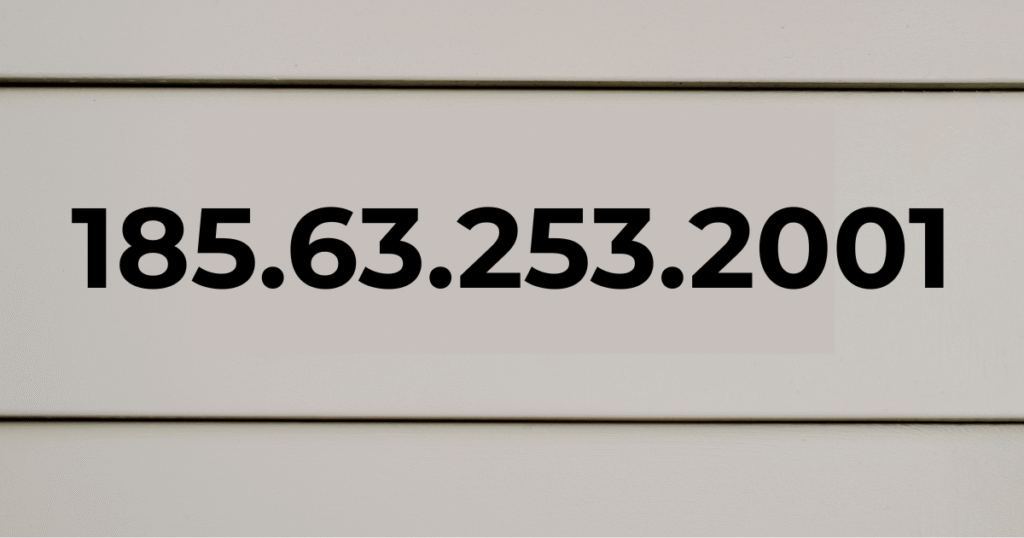
The keyword 185.63.253.2001 often appears in online searches related to IP tracking, cybersecurity analysis, or server identification. At first glance, it looks like a standard internet protocol (IP) address, but a deeper technical inspection reveals that 185.63.253.2001 does not follow the valid IPv4 addressing format. Despite this, the term continues to generate curiosity among users who want to understand its meaning, origin, and potential use cases.
This article explores 185.63.253.2001 in detail, explaining why it is technically invalid, how IP addresses are structured, why such entries appear online, and what users should do when encountering similar strings. Whether you are a website owner, network administrator, or curious internet user, this guide will clarify everything you need to know.
What Is 185.63.253.2001?
The value 185.63.253.2001 appears to resemble an IPv4 address, which is the most widely used IP addressing format on the internet. However, IPv4 addresses consist of four numerical segments, known as octets, separated by dots. Each octet must fall within the range of 0 to 255.
In the case of 185.63.253.2001, the last segment “2001” exceeds the allowed maximum value of 255. This makes 185.63.253.2001 an invalid IPv4 address, meaning it cannot be assigned to a device, server, or network node.
Understanding the Structure of IP Addresses
IPv4 Address Format Explained
To better understand why 185.63.253.2001 is invalid, it helps to review how IPv4 addresses work.
An IPv4 address looks like this:
Each “XXX”:
-
Must be a number between 0 and 255
-
Represents 8 bits of data
-
Helps identify network and host portions
Examples of valid IPv4 addresses include:
-
192.168.1.1
-
8.8.8.8
-
185.63.253.200
Because 185.63.253.2001 contains a four-digit octet, it violates the IPv4 standard.
IPv6 and Why 185.63.253.2001 Still Doesn’t Fit
Some users assume 185.63.253.2001 might be related to IPv6, the newer IP protocol. However, IPv6 addresses:
-
Use hexadecimal characters
-
Are separated by colons instead of dots
-
Appear much longer
Example of an IPv6 address:
Since 185.63.253.2001 uses dots and decimal numbers, it does not qualify as IPv6 either.
Why Does 185.63.253.2001 Appear Online?
Even though 185.63.253.2001 is invalid, there are several reasons why it may show up in logs, forums, or search results.
1. Typographical Errors
One of the most common reasons is human error. A user may accidentally type 185.63.253.2001 instead of a valid address such as:
-
185.63.253.201
-
185.63.253.200
Small mistakes like adding an extra digit can produce invalid IP-like strings.
2. Automated Bots and Crawlers
Some automated systems generate malformed IP addresses due to:
-
Misconfigured scripts
-
Faulty data parsing
-
Log formatting issues
In such cases, 185.63.253.2001 may appear temporarily in server logs.
3. Misinterpretation of Ports and IPs
In networking, ports are often written after IP addresses using a colon, such as:
When copied incorrectly, this can transform into 185.63.253.2001, leading to confusion.
Is 185.63.253.2001 Dangerous?
Security Perspective on 185.63.253.2001
From a cybersecurity standpoint, 185.63.253.2001 does not pose a direct threat because it is not routable or assignable. However, its presence may indicate:
-
Logging errors
-
Poor input validation
-
Potential spoofing attempts
While 185.63.253.2001 itself cannot attack a system, ignoring malformed data patterns could expose vulnerabilities elsewhere.
Should You Block 185.63.253.2001?
Blocking 185.63.253.2001 specifically is unnecessary, as it cannot exist as a real IP address. Instead, administrators should:
-
Validate IP inputs
-
Filter invalid formats
-
Monitor suspicious patterns
This proactive approach is far more effective than focusing on a single invalid string.
SEO and Web Analytics Confusion Around 185.63.253.2001
Appearance in Analytics Tools
Website owners sometimes notice 185.63.253.2001 in:
-
Access logs
-
Traffic analytics
-
Error reports
This usually happens due to:
-
Corrupt data entries
-
Incorrect log parsing
-
Third-party tool glitches
Understanding that 185.63.253.2001 is invalid helps prevent unnecessary panic or misinterpretation of traffic sources.
Impact on Website Performance
The presence of 185.63.253.2001 in logs does not affect website performance directly. However, repeated malformed entries may:
-
Inflate error logs
-
Obscure real traffic data
-
Complicate debugging processes
Regular log maintenance and validation can prevent these issues.
How to Identify Valid vs Invalid IP Addresses
Simple Validation Rules
To avoid confusion with entries like 185.63.253.2001, always check:
-
Number of segments (must be four for IPv4)
-
Numerical range (0–255 per segment)
-
Correct separators (dots for IPv4)
Any address failing these checks is invalid.
Using IP Validation Tools
Online IP validators can instantly confirm whether an address is valid. When tested, 185.63.253.2001 will always fail validation, confirming it cannot function in real-world networking.
Common Myths About 185.63.253.2001
Myth 1: It Belongs to a Hidden Server
False. 185.63.253.2001 cannot belong to any server because it violates IP standards.
Myth 2: It Is a Secret IPv6 Address
Incorrect. IPv6 uses a completely different structure.
Myth 3: It Can Be Tracked Geographically
Impossible. Only valid IP addresses can be geolocated.
Best Practices When Encountering 185.63.253.2001
If you come across 185.63.253.2001, follow these best practices:
-
Do not attempt geolocation
-
Avoid blocking it manually
-
Investigate data source integrity
-
Improve validation rules in forms and logs
These steps ensure accurate data handling and better security.
The Role of Data Accuracy in Modern Networking
Invalid entries like 185.63.253.2001 highlight the importance of clean data in modern digital systems. Whether in analytics, cybersecurity, or server management, accurate IP handling ensures:
-
Reliable reporting
-
Improved security posture
-
Better decision-making
Understanding why is invalid helps users avoid misinformation and technical confusion.
Conclusion: Final Thoughts on 185.63.253.2001
In summary, is not a valid IP address, despite appearing to resemble one. Its incorrect structure places it outside the rules of both IPv4 and IPv6 protocols. While it may appear in logs or online discussions due to human error, automated systems, or formatting issues, it does not represent a real network entity.
By understanding the technical limitations behind , users can better interpret network data, avoid unnecessary security concerns, and maintain cleaner digital environments. Knowledge of IP standards remains essential in today’s connected world, and recognizing invalid formats is a key part of that literacy.
Frequently Asked Questions (FAQs)
1. Is 185.63.253.2001 a real IP address?
No, 185.63.253.2001 is not a real IP address because the last segment exceeds the allowed IPv4 range.
2. Can 185.63.253.2001 be traced or located?
No, geolocation is impossible since is invalid and not assigned to any device.
3. Why does 185.63.253.2001 show up in server logs?
It usually appears due to formatting errors, misconfi ripts, or incorrect data parsing.
4. Is 185.63.253.2001 harmful to my website?
No direct harm is caused by , but frequent invalid entries may indicate data quality issues.
5. How can I prevent invalid IPs like 185.63.253.2001?
Use strict IP validation rules, clean log data regularly, and monitor unusual input patterns.
